SoroSentinel
Security tooling for the Stellar ecosystem. How its signals work, what is actually live, and how to check its output yourself.
SoroSentinel
Security tooling for the Stellar ecosystem. It advises: it never controls the network, never touches a private key, and never signs anything for you.
Stellar’s classic layer has no arbitrary code, so the interesting risks are narrower than general malware: a contract that can replace its own code, a transaction that quietly adds a signer, an asset with a familiar code issued by somebody else, or a domain that no longer matches the issuer’s record. SoroSentinel analyzes those and describes what it observed.
Watch it work
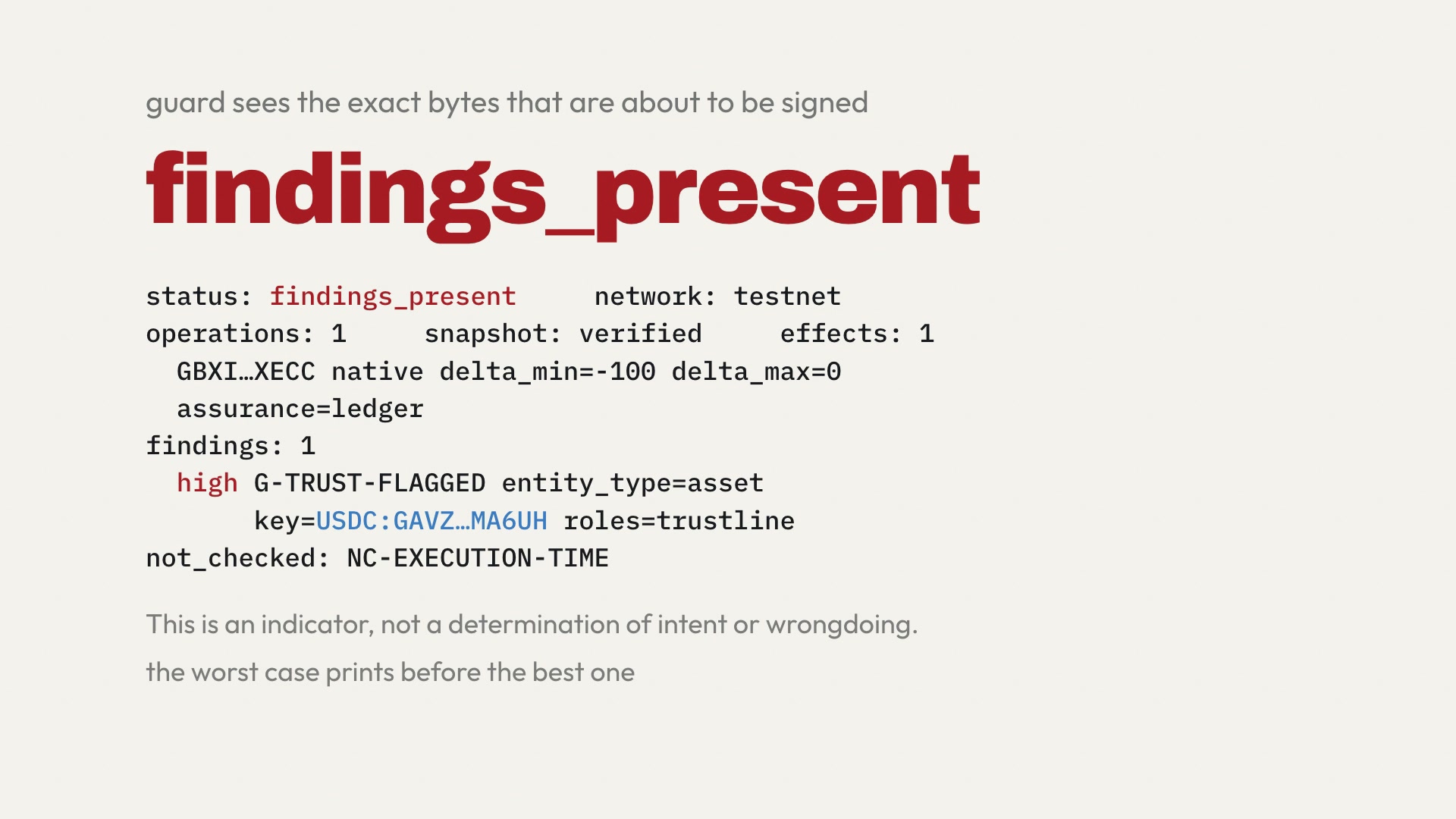
The film above shows the complete flow running across testnet in one command (make demo, 4 minutes 8 seconds, measured on 2026-11-01):
- A look-alike asset is issued on testnet.
- Ingestion records immutable evidence rows in the database.
- The rule table evaluates the evidence and assigns a
cautionsignal. - An Ed25519-signed snapshot is published.
- The read API answers with the finding facts.
- Guard analyzes the transaction envelope offline and returns
findings_presentwithG-TRUST-FLAGGED. - A control transaction returns
no_issues_found.
[!NOTE] Protocol 30 schedule notice: Testnet upgrades to Protocol 30 on 2026-11-03 17:00 UTC. During the 4.5-hour dependency cooldown until
go-stellar-sdkv0.8.0 clears (2026-11-03 21:30 UTC), ingestion halts by design rather than guessing unknown XDR structures. See the status page for details.
The three components, one pipeline
[ Soroban Contract WASM ]
           │
           ▼
[ sorosentinel-scan ] (Rust)
           │  ScanReport JSON
           ▼
[ sorosentinel-intel ] (Go) ◀── Stellar RPC Ledgers & SEP-1 Domains
           │  Ed25519 Signed Snapshot & Read API
           ▼
[ sorosentinel-guard ] (TypeScript SDK)
           ▲
           │  Raw XDR Envelope (Pre-Signing)
   [ Stellar Wallet / User ]
| Component | Language | Role | Repository |
|---|---|---|---|
| Guard | TypeScript | Pre-signing transaction analysis SDK for wallets. Intercepts XDR envelopes, simulates Soroban calls, derives worst-case net balance deltas, and verifies snapshots offline. | sorosentinel-guard |
| Intel | Go | Evidence and threat intelligence backbone. Reads ledgers via Stellar RPC, validates SEP-1 home domains, computes reproducible rule-based signals, and publishes signed snapshots. | sorosentinel-intel |
| Scan | Rust | Sandboxed static analysis library and CLI. Parses compiled Soroban contract WASM bytecode without network access or execution, validating SEP-41 interfaces and resource limits. | sorosentinel-scan |
Data flows in one direction: Scan → evidence → Intel → signed snapshot → Guard. Repositories never import each other’s internals; they communicate exclusively through versioned schemas owned by Intel.
Quickstart guides by role
For wallet integrators (Guard SDK)
Guard runs client-side in the wallet before a user signs. It derives the net balance effects per account and checks counterparties against offline snapshots:
import { analyze } from "@sorosentinel/guard-core";

// Analyze transaction bytes before displaying the signing prompt
const report = await analyze(transactionEnvelopeXDR, {
  networkPassphrase: "Test SDF Network ; September 2015",
  rpcUrl: "https://soroban-testnet.stellar.org",
  snapshotPath: "./snapshots/latest.bin",
});

if (report.status === "findings_present") {
  // Show findings ordered by severity, worst-case balance deltas, and unexamined items
  console.log("Findings:", report.findings);
  console.log("Account Balance Deltas:", report.effects);
  console.log("Not Checked:", report.not_checked);
} else if (report.status === "no_issues_found") {
  console.log("No issues observed across checked rules.");
}
Detailed guide: What Guard reports.
For contract authors and auditors (Scan CLI)
Scan inspects deployed Soroban contract WASM in a locked-down sandbox (--network none, 256 MiB RAM, seccomp filter). It outputs deterministic JSON and SARIF:
# Analyze contract bytecode locally
cargo run -p scan-cli -- path/to/contract.wasm --format json

# Or generate SARIF for CI workflows
cargo run -p scan-cli -- path/to/contract.wasm --format sarif
Detailed guide: What Scan reports.
For node operators and indexers (Intel API)
Intel runs ingestion workers that tail Stellar RPC ledgers, evaluate rule tables, and publish cryptographically signed snapshots:
# Start the Intel read API
go run ./cmd/intel-api -snapshot-dir ./snapshots -db "$INTEL_DATABASE_URL"

# Verify a downloaded snapshot offline with Ed25519 public key
# (See verifying-snapshots for test vectors and format spec)
Detailed guide: Verifying a snapshot yourself and What Intel publishes.
Core invariants
Absence of a result is never reassurance. If analysis fails, times out, or encounters an unknown operation or credential type, the answer is partial or unanalyzable. A tool that returns a clean result when it failed is worse than no tool. SoroSentinel never outputs “safe”.
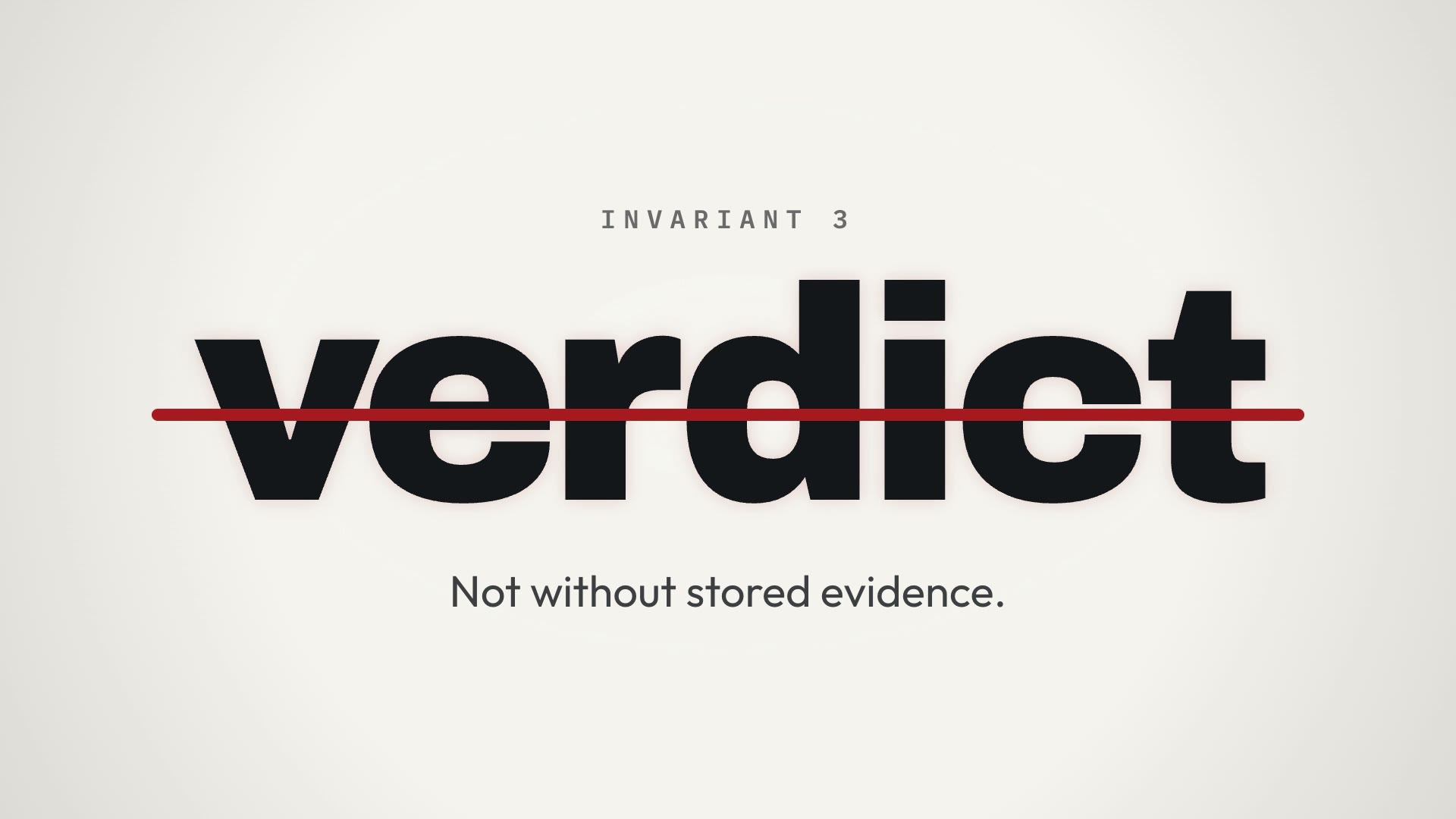
No status without stored evidence. Every signal points directly to the immutable database rows that produced it, along with the inspection timestamp (as_of) and ruleset version. Verdicts are a reproducible rule table over (evidence, as_of, ruleset_version) — never an arbitrary score or subjective guess.
Public text is fixed and reviewed. User-facing sentences come only from an approved registry of wording templates filled with observed facts. If a template cannot render exactly, the system fails closed, returning structured facts without prose.
Money is integers. Amounts are 7-decimal fixed-point integers (stroops). The system never uses floating-point arithmetic for balances or fees.
Documentation & Reference
- What Guard reports — 8 finding codes and 7 not-checked codes.
- What Scan reports — 7 capability indicators, interface validation rules, and caps.
- What Intel publishes — 4 public signal names (
consistent,no_signals,caution,high_caution). - Verifying a snapshot yourself — snapshot format specification and shared test vectors.
- Project status — verified testnet runs, test coverage, and Protocol 30 window.
- How SoroSentinel compares — StellarExpert, Assay, Stellar Agent Guard, contract scanners and transaction explainers.
- GitHub Organization — source code for Intel, Guard, and Scan.